State of California –
Mobile Voting Platform
4.7%
Overseas citizen vote rate in 2018 midterms
~60pt
Voting gap between domestic and overseas citizens
3x
More likely to vote with electronic ballot access
2.9M
Overseas citizens eligible to vote in 2018
My Role
Project Manager · UX Researcher · UX Designer · Report Writer
Client
State of California
(concept pilot)
Duration
2 weeks · October 2020
Tools
Figma · Miro · Marvel · Adobe XD
The Challenge
A 60-Point Gap Between Intent and Action
Overseas citizens are thirteen times less likely to vote in US elections than stateside citizens. The COVID-19 pandemic accelerated the urgency — and the opportunity.
The COVID-19 global pandemic made it more difficult for some populations to vote, accelerating the exploration of mobile voting by many states. In this case study, the State of California considers a pilot online voting platform for overseas voters — allowing a small subset to receive, vote on, and submit their ballots electronically. It was believed that citizens are generally concerned about the security of this technology, so security and trust factors were highly considered in the design of this platform.
Why It Matters
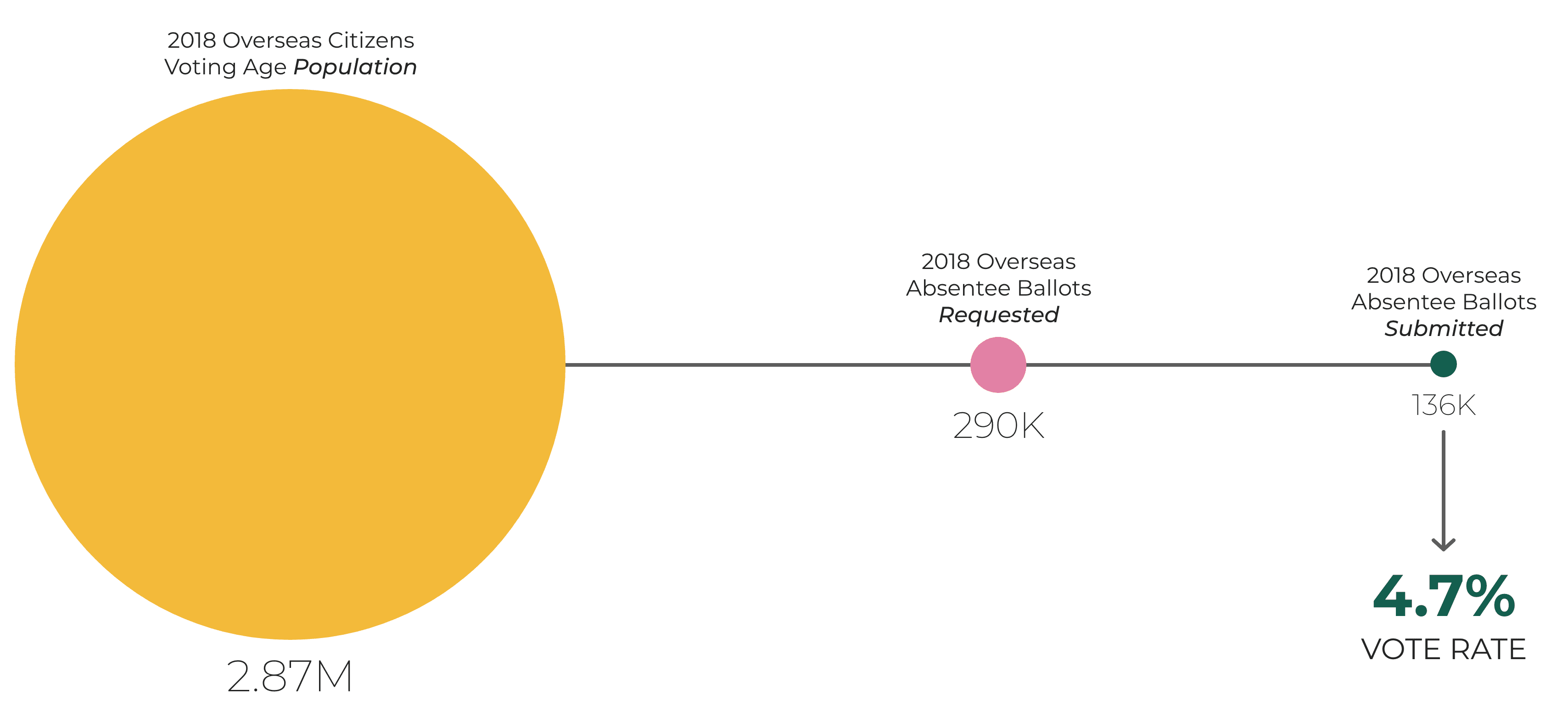
After the 2018 United States midterm elections, the Federal Voting Assistance Program released a report analyzing the Overseas Citizens Voting Age Population. During the 2018 midterm election year, approximately 2.9M citizens were eligible to vote in US federal elections. However, an estimated total of 136K ballots were submitted by such citizens — equating to a vote rate of 4.7%.
Let's try to visualize that, shall we?
Better yet, let's compare the overseas citizens vote rate to the domestic citizens vote rate from the same 2018 midterm election year.
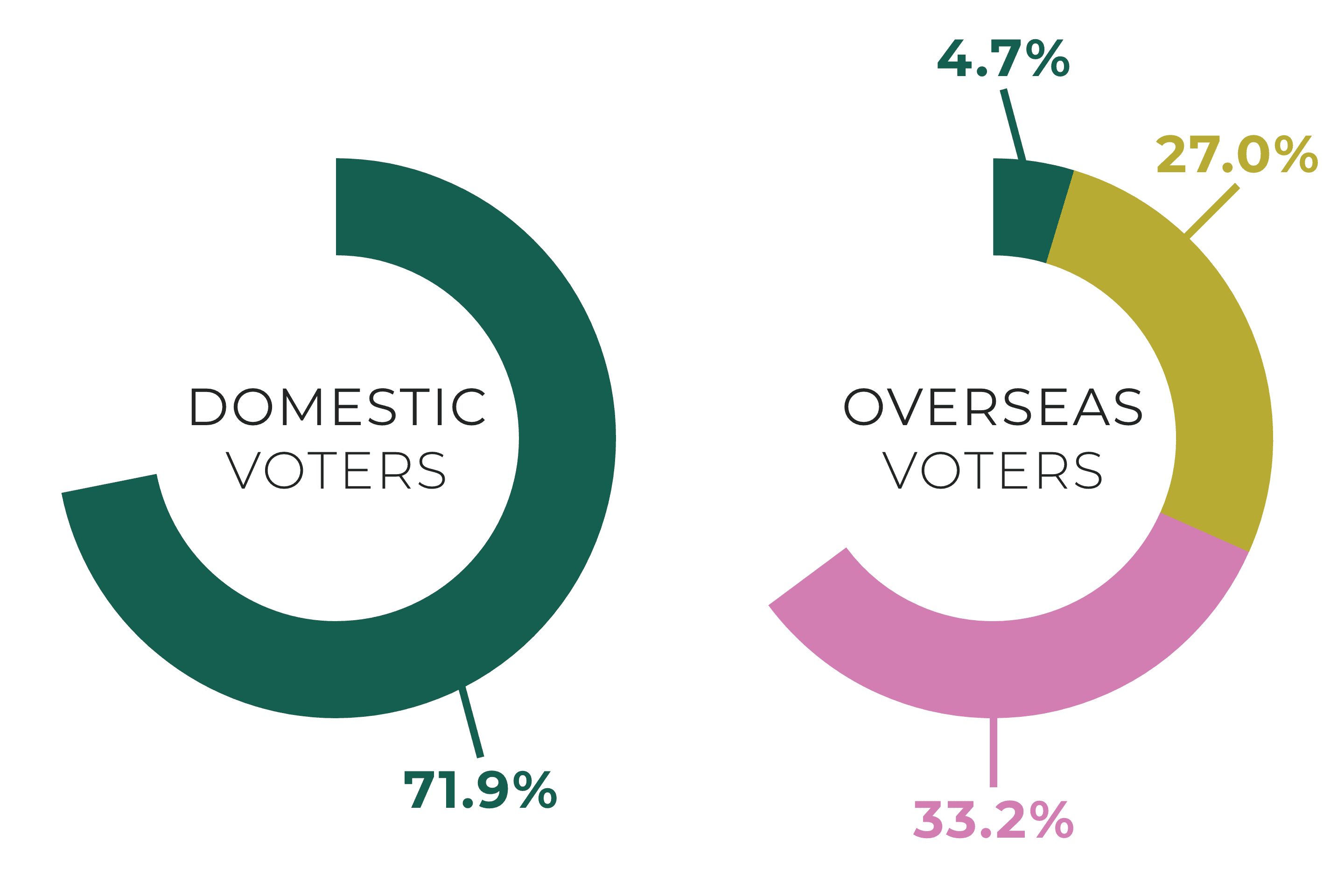
Vote Rate
Domestic: Respondents in the U.S. Census Bureau's Current Population Survey who answered "yes" when asked if they voted in this year's election.
Overseas: Percentage of OCVAP that submitted a ballot and had a vote recorded in state vote history records.
Obstacle Gap
Percentage of overseas citizens who tried to vote but were unsuccessful.
This includes factors that affect one's ability to transmit and receive election related materials in a timely manner.
Residual Gap
Percentage of overseas citizens who did not vote because of factors that cannot be resolved within the voting process.
This includes factors related to motivational differences, election importance, or lack of connection to U.S. politics.
In the 2018 United States federal elections, there was an approximate 60-point voting gap between the domestic citizen and the overseas citizen vote rates. To better define areas for opportunity where the voting gap may be reduced, our team took a deeper dive into the main drivers influencing both the obstacle gap and the residual gap, as researched and defined by the Federal Voting Assistance Program.
Key Drivers from FVAP Research
01
Time taken for election materials to travel between overseas voters and their election officials is a significant challenge.
02
Mailing systems outside the United States are often perceived as being unreliable.
03
Those who received electronic absentee ballots were more than 3 times as likely to vote than those who did not.
04
Social context in which one lives strongly affects one's likelihood of voting.
05
Those who can electronically return their ballots are more likely to perceive requesting the ballot as "worth the effort."
The Opportunity
Understanding What Stands Between Voters and the Polls
Before designing anything, we needed to understand the current voting experience and what barriers were actually creating the gap.
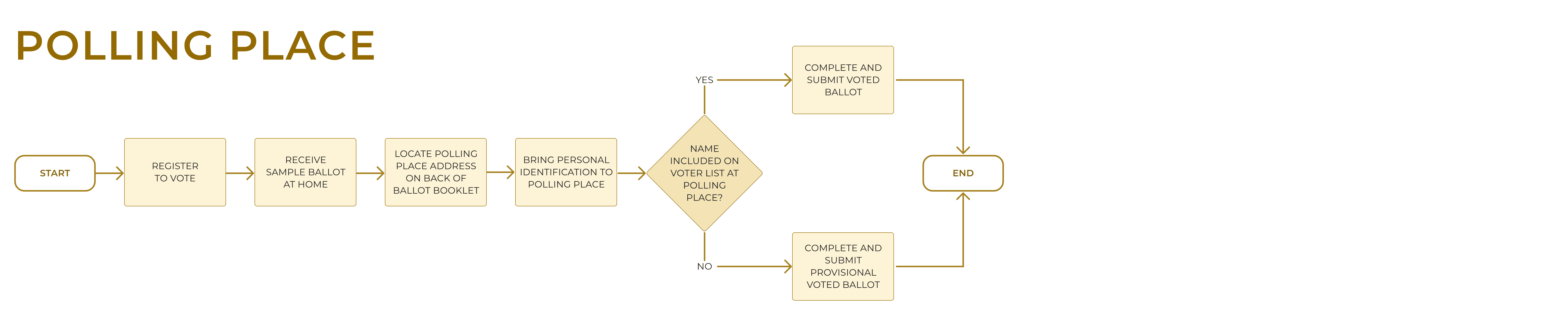
Current Voting Methods
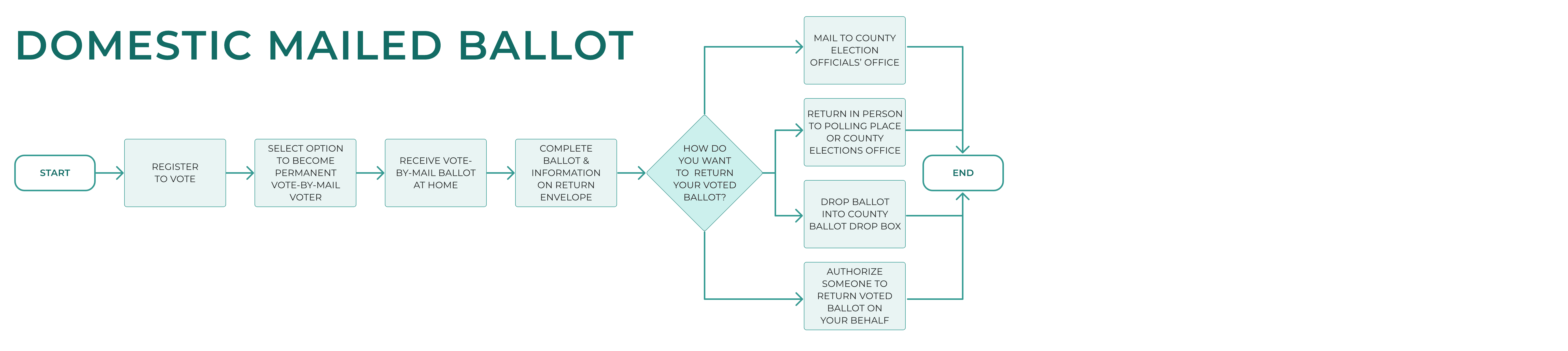
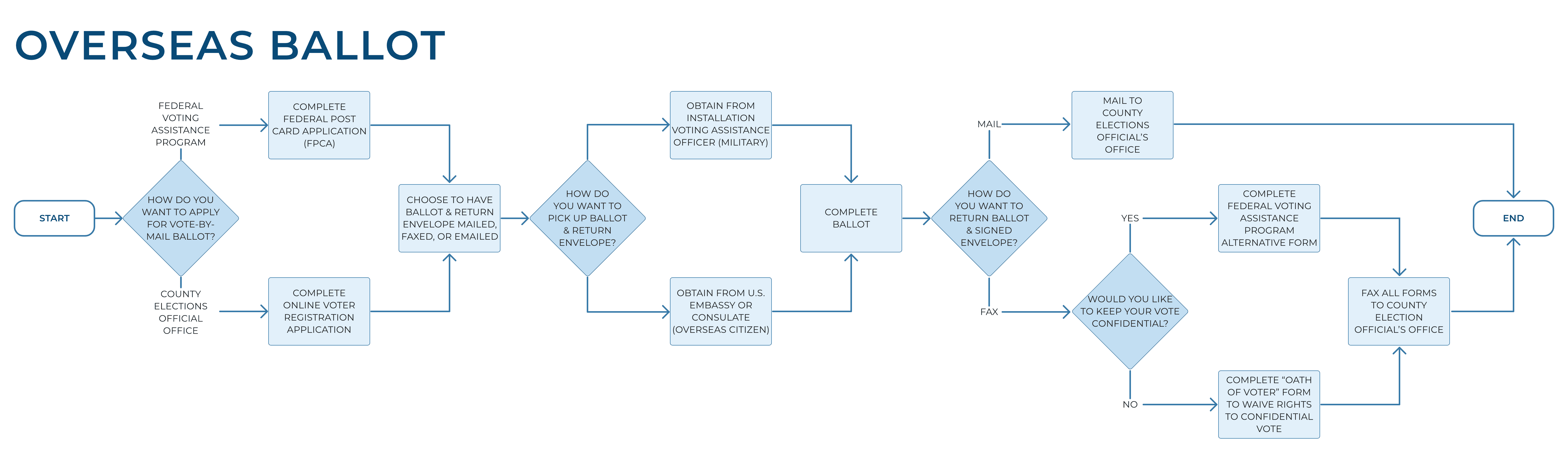
To understand the common pain points felt by overseas voters from the State of California, we prepared a competitive task analysis of the state's available voting methods. By deconstructing each voting method on a step-by-step basis, our team was able to determine what voters were trying to accomplish, diagnose potential pain points, and identify areas of opportunity to create a more effective and efficient voting process.
Security Feature Analysis
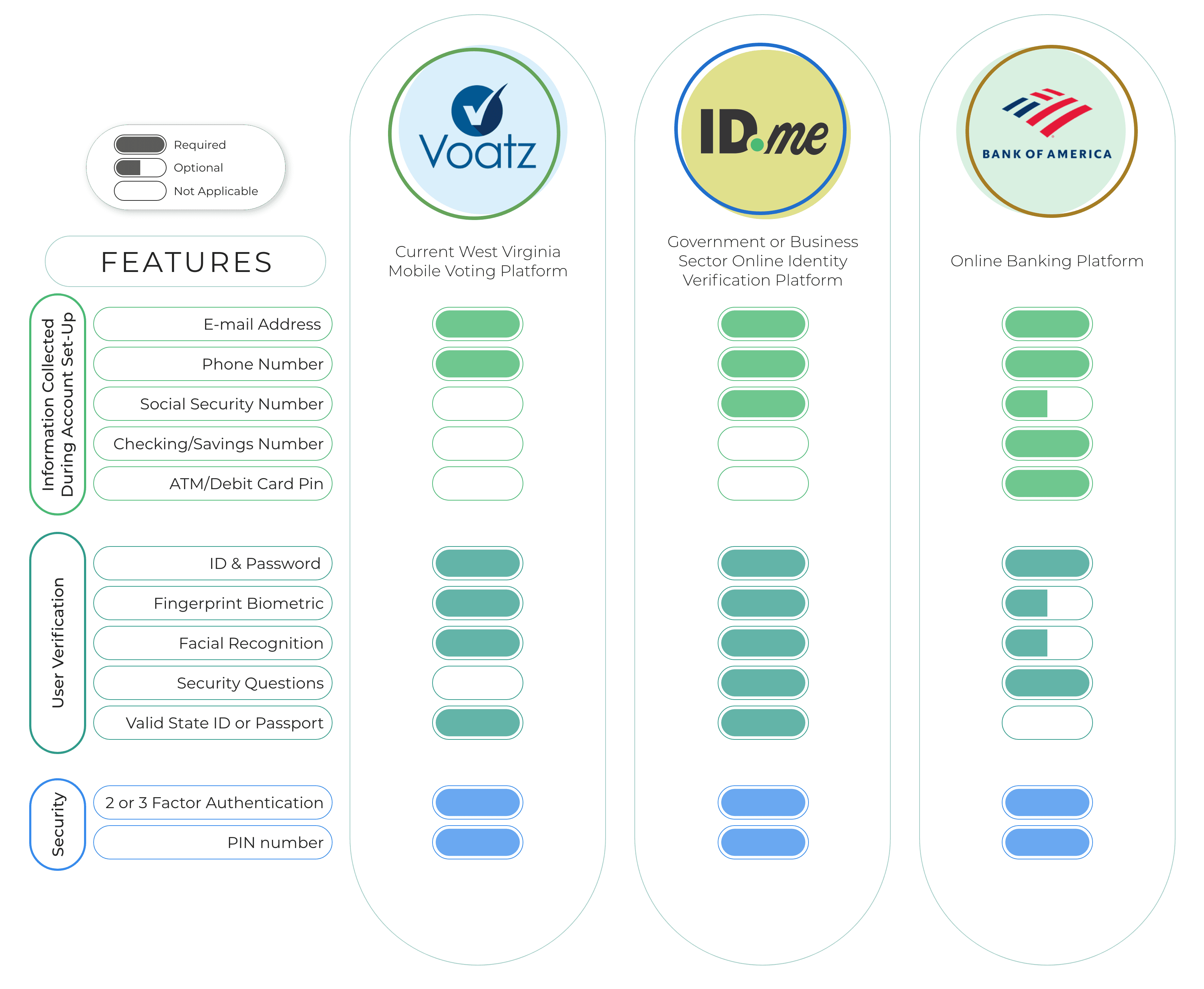
Due to the sensitivity of the remote voting process and the strong desire for a confidential vote, our team conducted a competitive feature analysis to understand how other trusted online platforms authenticate and secure users' personal information. We compared West Virginia's mobile voting application Voatz, identity verification platform ID.me, and Bank of America's online banking platform — examining account setup, user verification protocols, and additional authentication measures.
Design Implication
The security patterns that users already trusted — two-factor authentication, electronic signature, identity verification — provided a ready-made vocabulary for building confidence in a new platform. We didn't need to invent new trust signals. We needed to apply familiar ones carefully.
User Research
We interviewed four individuals who had voted in current or previous elections. Interviews covered two areas: security and trust concerns, and previous voting experiences. Using affinity mapping, our team identified a number of shared pain points, goals, and needs. Key insights included:
Primary Concerns
Absentee ballots getting lost in the mail
Ballot not being appropriately counted
Skepticism about voting and releasing personal information online
Issues obtaining absentee ballots in past elections
Core Desires
A more convenient overall voting process
More knowledge of candidates on the ballot
Confidence that their vote was counted
A process that felt secure without being burdensome
Journey Map
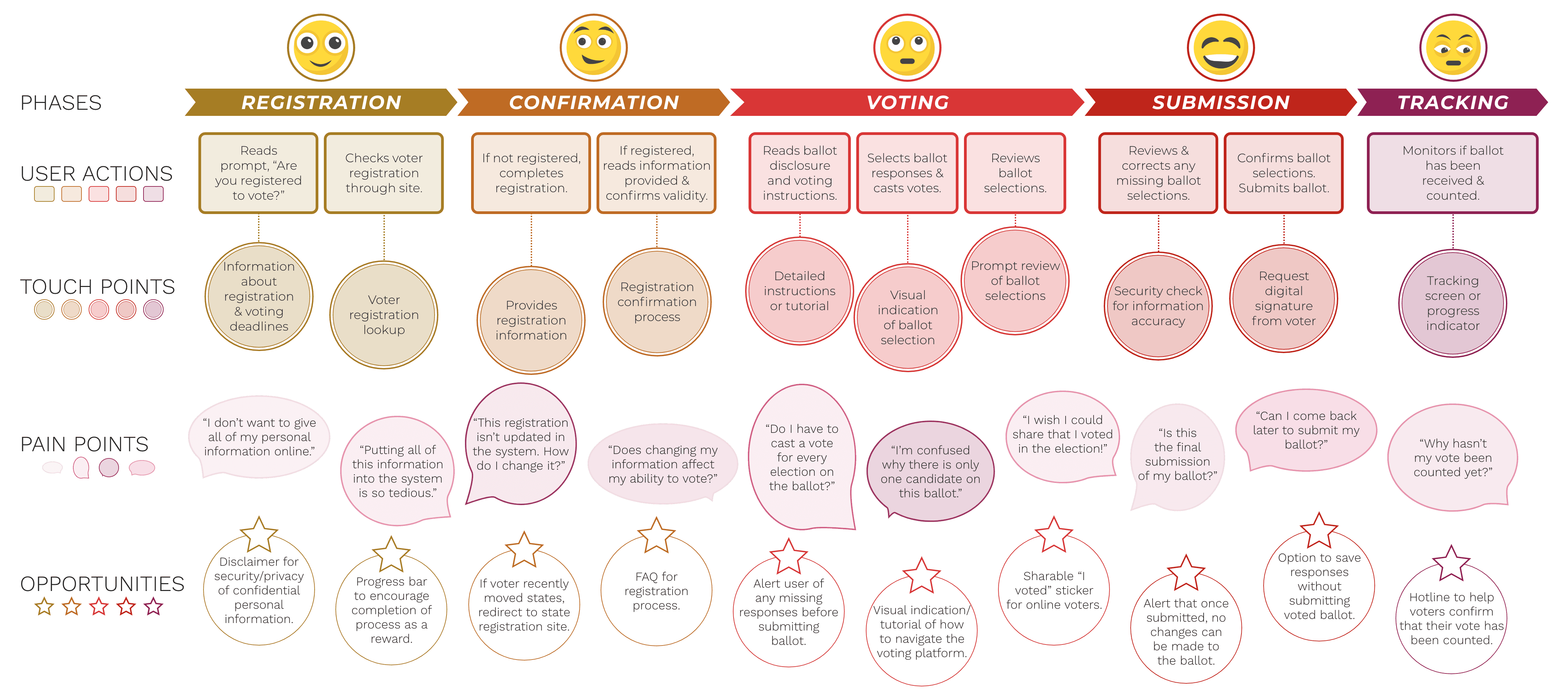
To further understand the current voter experience and identify where the platform could have the greatest impact, our team mapped the end-to-end journey of an overseas voter attempting to cast a ballot. The journey map below captures the user's actions, thoughts, and emotional state at each stage of the process.
The Solution
Three Steps Designed Around Trust
Every design decision — from registration to ballot submission to post-vote tracking — was made with one question in mind: does this make the voter feel confident their vote is secure and will be counted?
01
Register to Vote
Rather than building a redundant registration process, we integrated with existing California and federal resources — issuing a unique 6-digit voter registration PIN upon registration. Early usability testing showed our original registration flow was confusing and repetitive; this simplified approach reduced friction while increasing security perception.
02
Cast Your Vote
Following Nielsen's heuristic that interfaces should match real-world conventions, we presented the ballot in its traditional appearance rather than modernizing it. A 45-minute timer, a ballot review screen, and the ability to correct selections before final submission addressed the fear of making uncorrectable mistakes.
03
Submit & Track
Electronic signature as the final submission step reinforced the legal weight and confidentiality of the vote. Post-submission ballot tracking via email or SMS directly addressed the fear that ballots would disappear. A shareable "I voted" sticker added a social dimension that research shows increases voter turnout.
Wireframes – Step-by-Step Flows
The three-step structure above was translated into detailed wireframe flows for each stage of the experience. Refer to the wireframes below for the complete interaction design for each step.
Step 1: Register to Vote
Our paper and lo-fi prototype usability tests indicated that the design of our voter registration process was confusing and repetitive. Further, users expected higher security measures when registering through our platform.
In short, the registration process we designed was not meeting our goal of providing an efficient, trustworthy, and streamlined voting platform for our overseas voters.
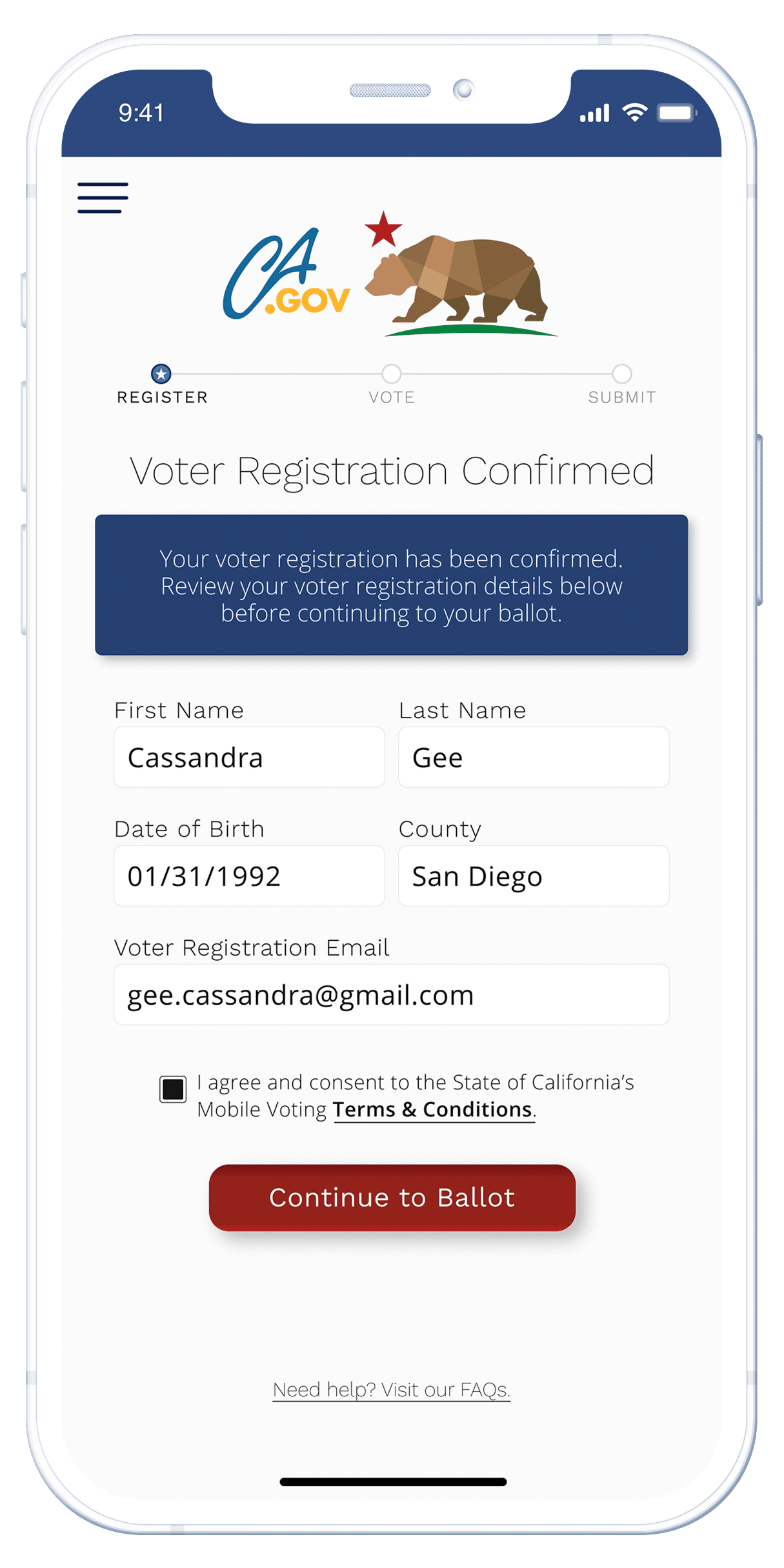
So, rather than building out a separate registration process within our voting platform, our team determined it to be more cost and time efficient to use the current available registration resources provided by the State of California and the United States federal government. Upon registering, overseas voters will now be provided with a unique 6-digit voter registration PIN number.
Our final prototype included several different user paths within the registration process, which are further explained below.
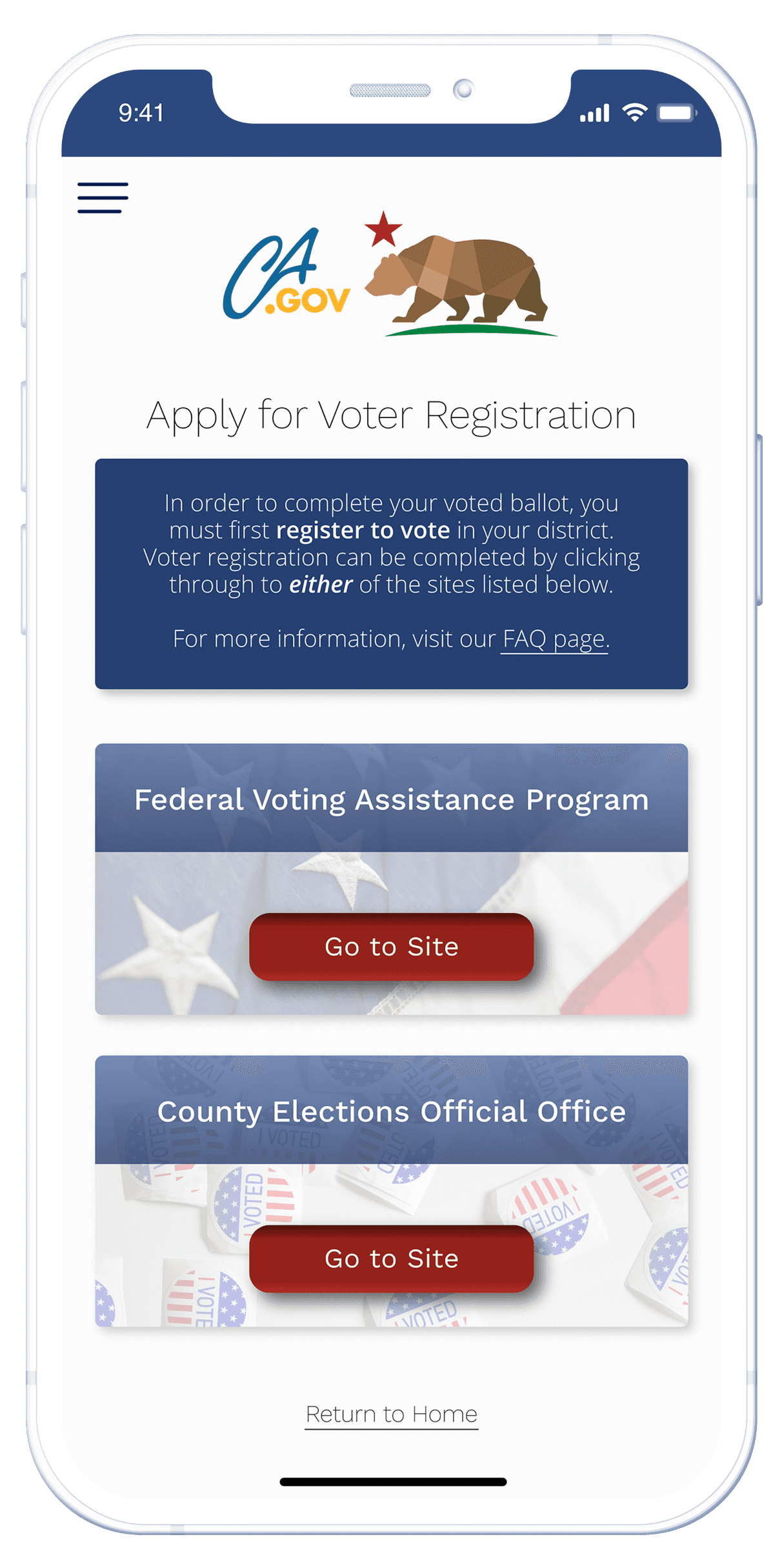
What if I haven’t registered to vote?
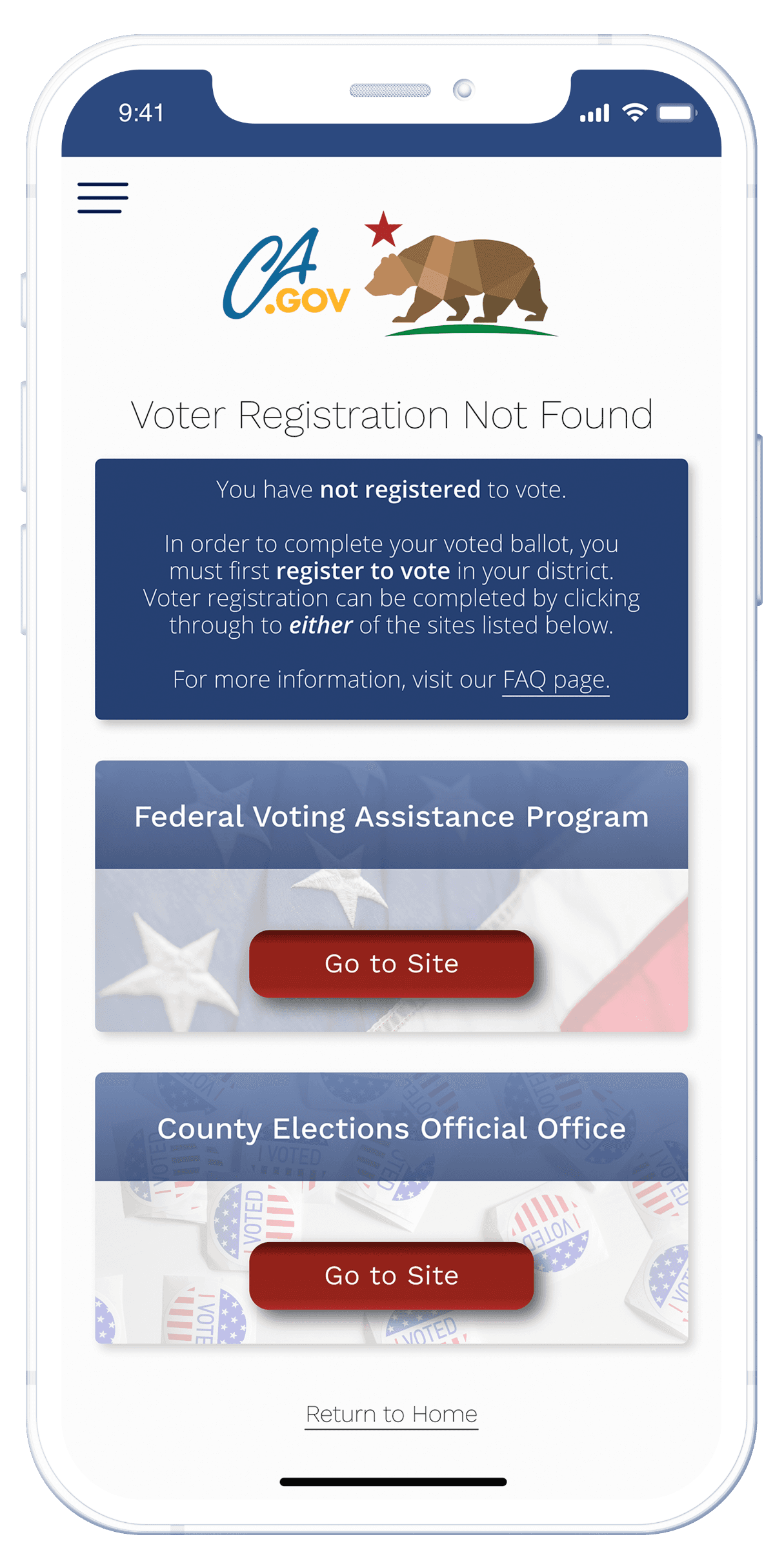
For your convenience, voter registration resources are linked on our website.
The State of California's overseas voters can apply for voter registration by completing either (a) an online voter registration application with your designated county elections officials' office, or (b) the Federal Post Card Application (FPCA) on the Federal Voting Assistance Program's website.
How do I find my voter registration pin number?
For your convenience, voter registration resources are linked on our website.
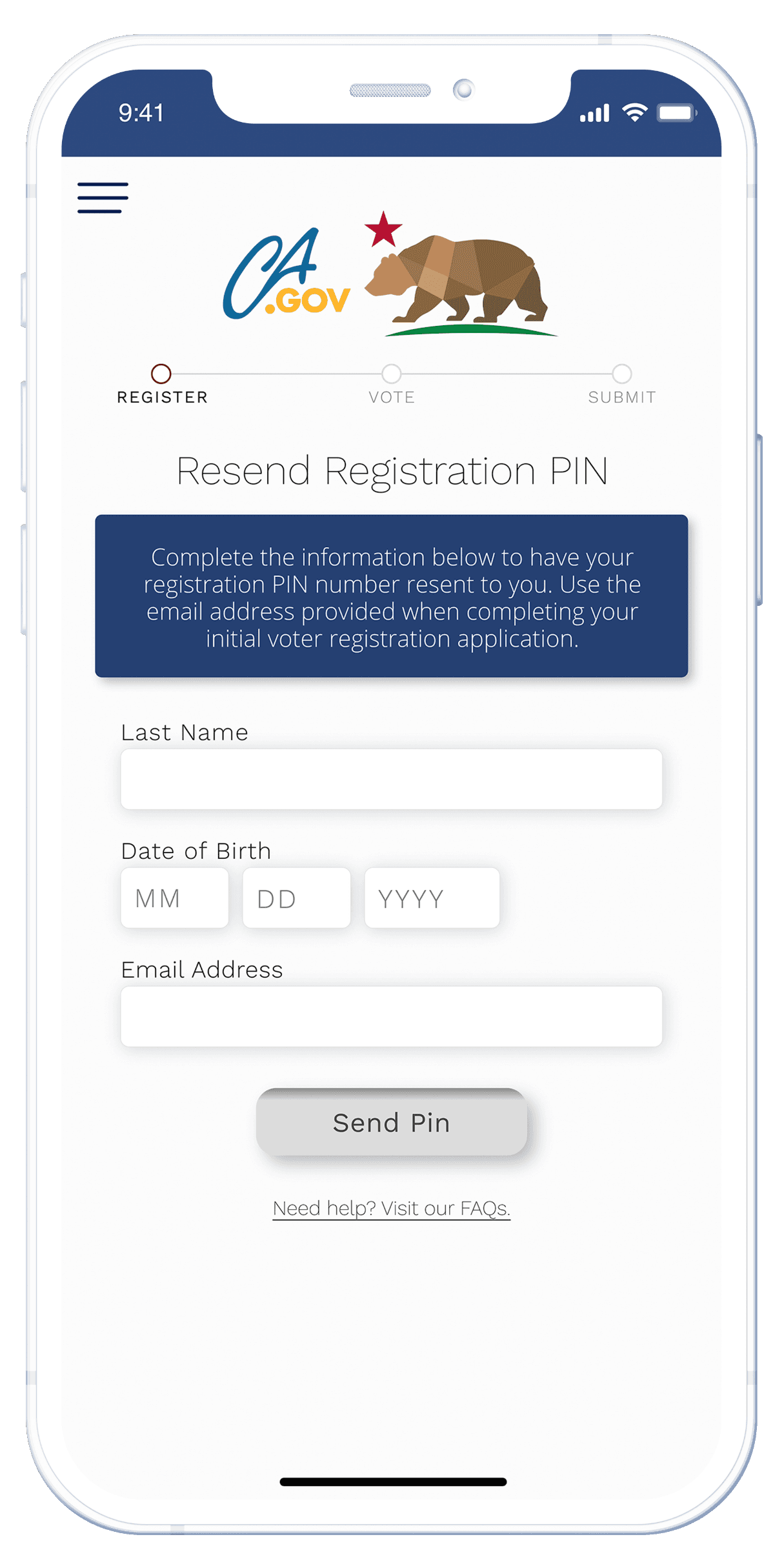
Upon registering to vote through one of the two available resources, you will be provided with a unique 6-digit voter registration PIN number via email.
What if I can't remember if I registered to vote?
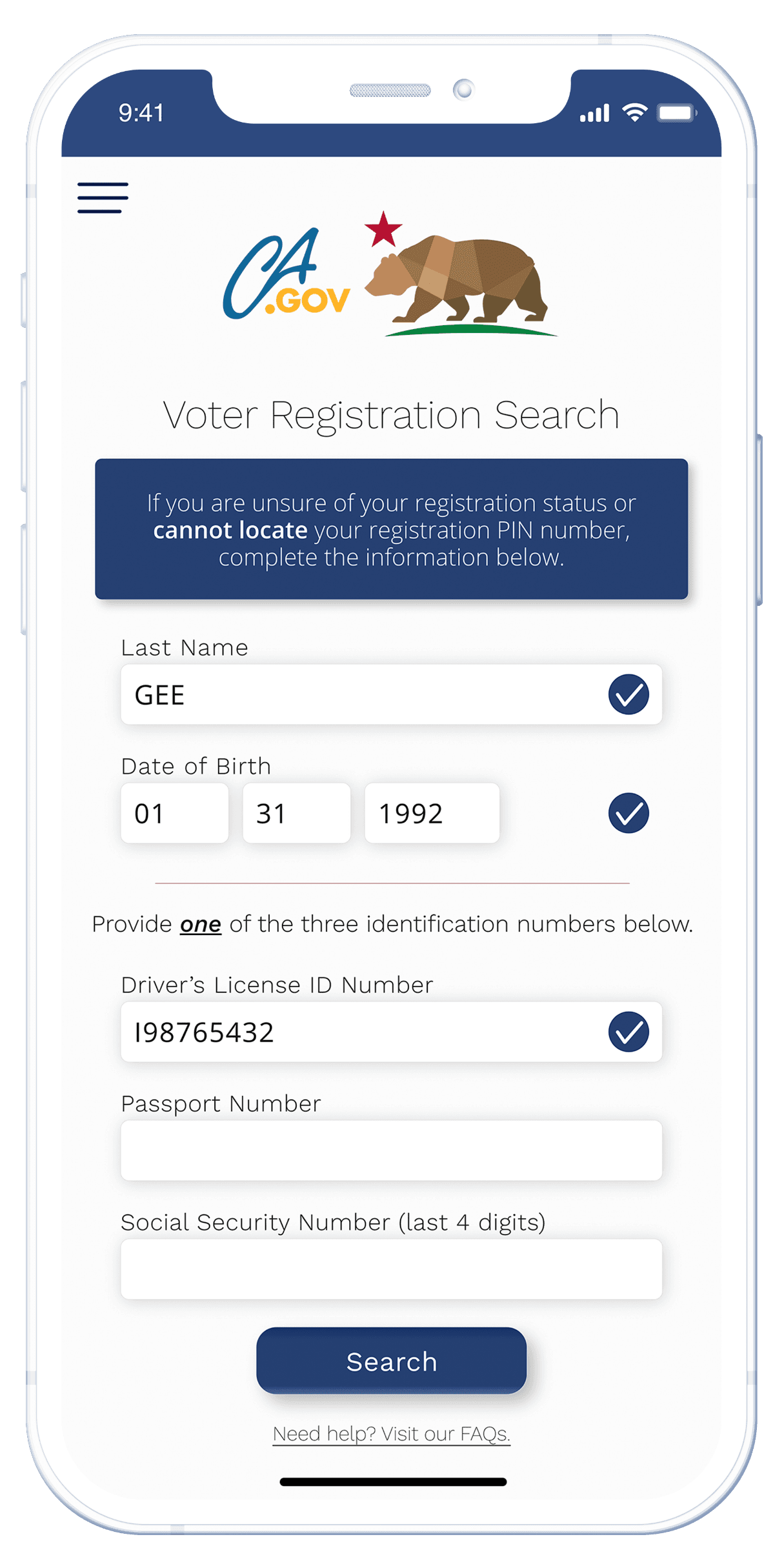
If you either (a) cannot remember whether or not you have registered to vote, or (b) cannot locate your voter registration PIN number, you can use the voter registration search available on our website.
You will need to provide your last name, date of birth, and one of the following: (i) driver's license number, (ii) passport number, or (iii) the last four digits of your social security number.
If you have previously registered to vote, you will be able to resend your registration pin number to the email address you provided upon initial registration.
If you have not previously registered to vote, you will be redirected to a screen that provides you with available registration resources.
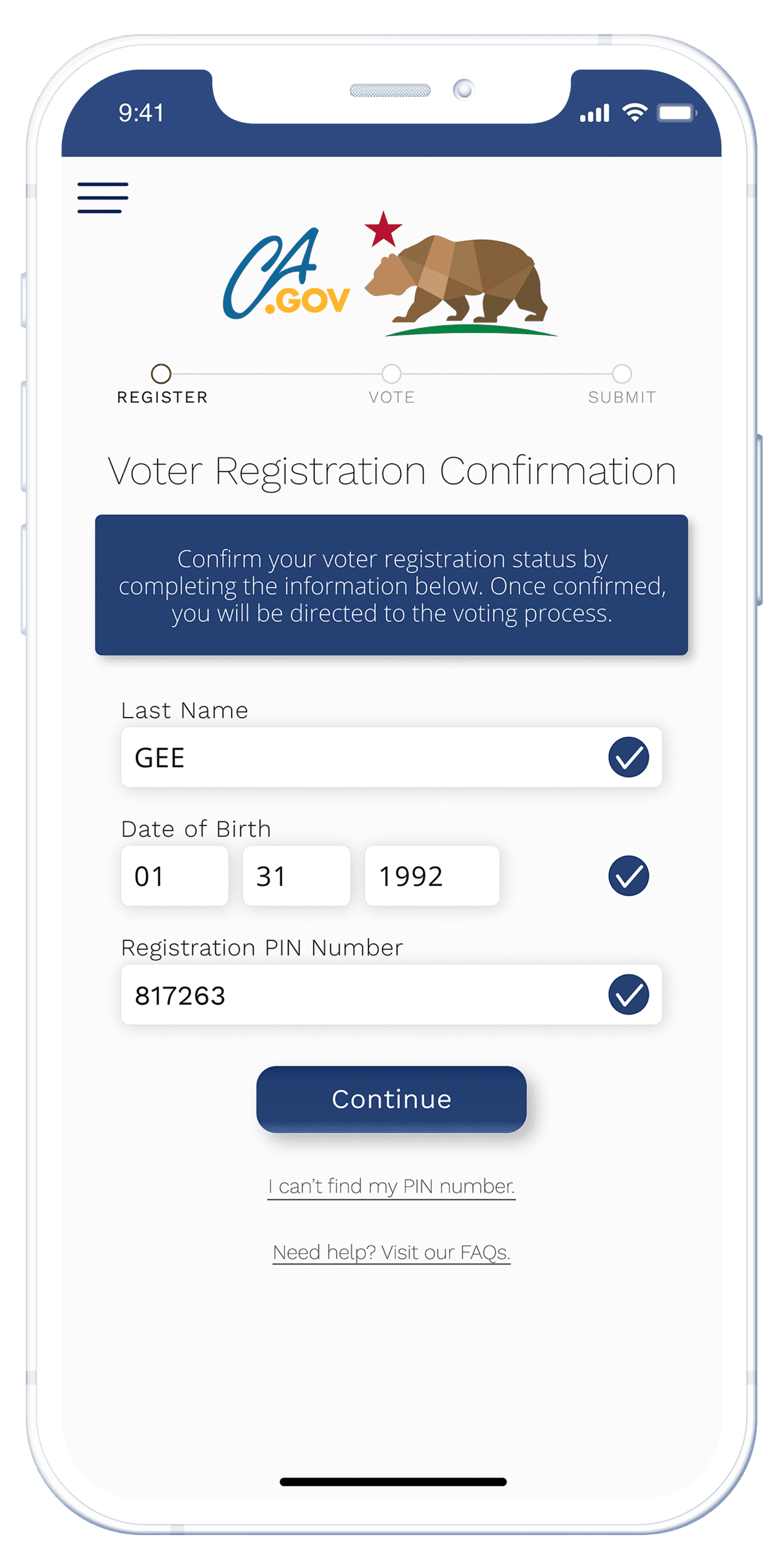
What all is required to confirm my voter registration?
Your voter registration can be confirmed on our site by providing your last name, your date of birth, and your unique 6-digit voter registration PIN number.

Step 2: Cast Your Vote
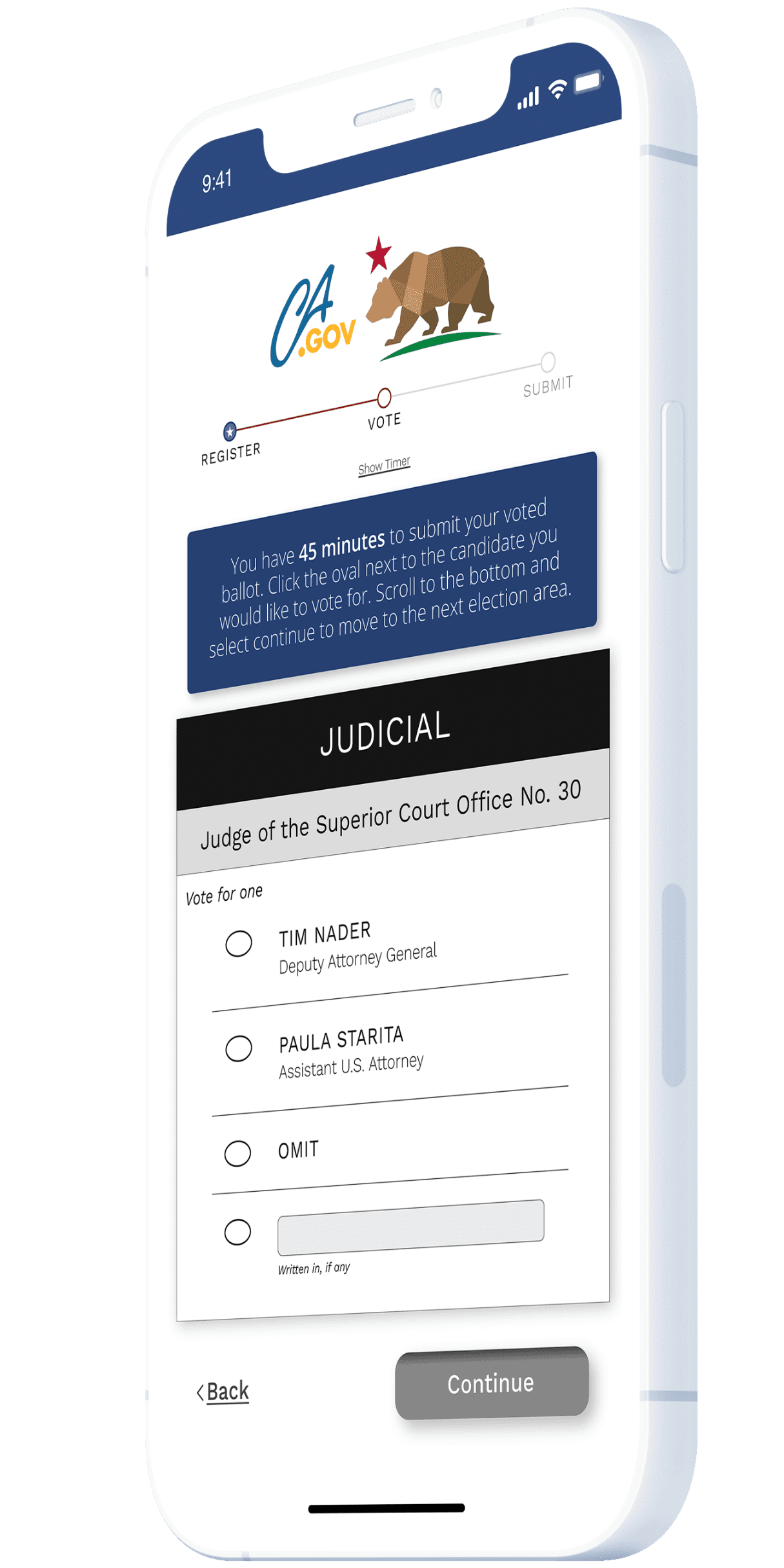
Jakob Nielsen's second usability heuristic asserts that user interfaces should follow real-world conventions and present information in a natural and logical order. In other words, there should be an easily recognizable association between the system and the real world.
For this reason, instead of modernizing the appearance of the ballot to better conform to current day user interface patterns, our team concluded that presenting the election ballot in its traditional appearance would create a more intuitive, user-friendly experience for potential users.
How much time do I have to complete my ballot?
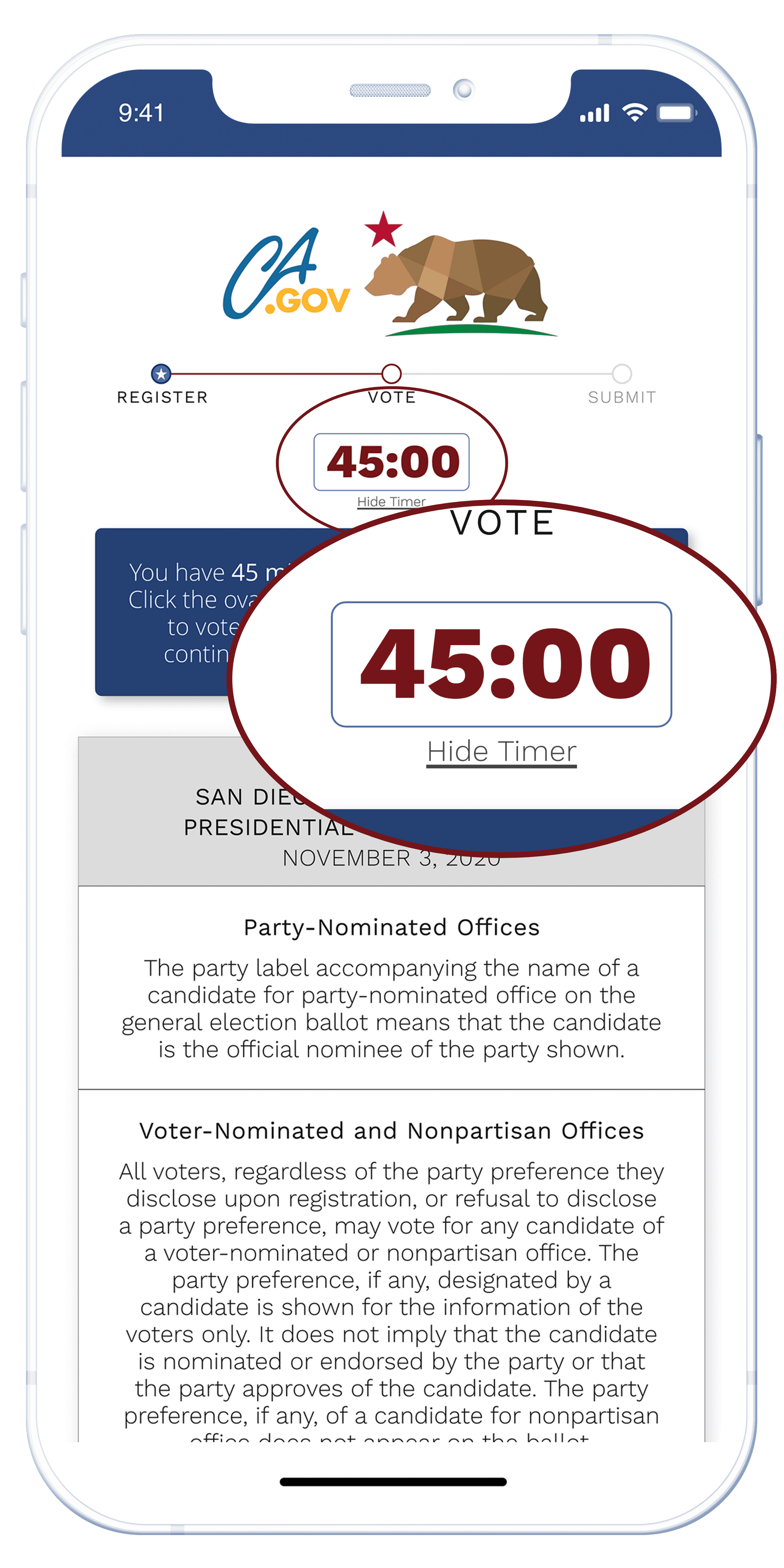
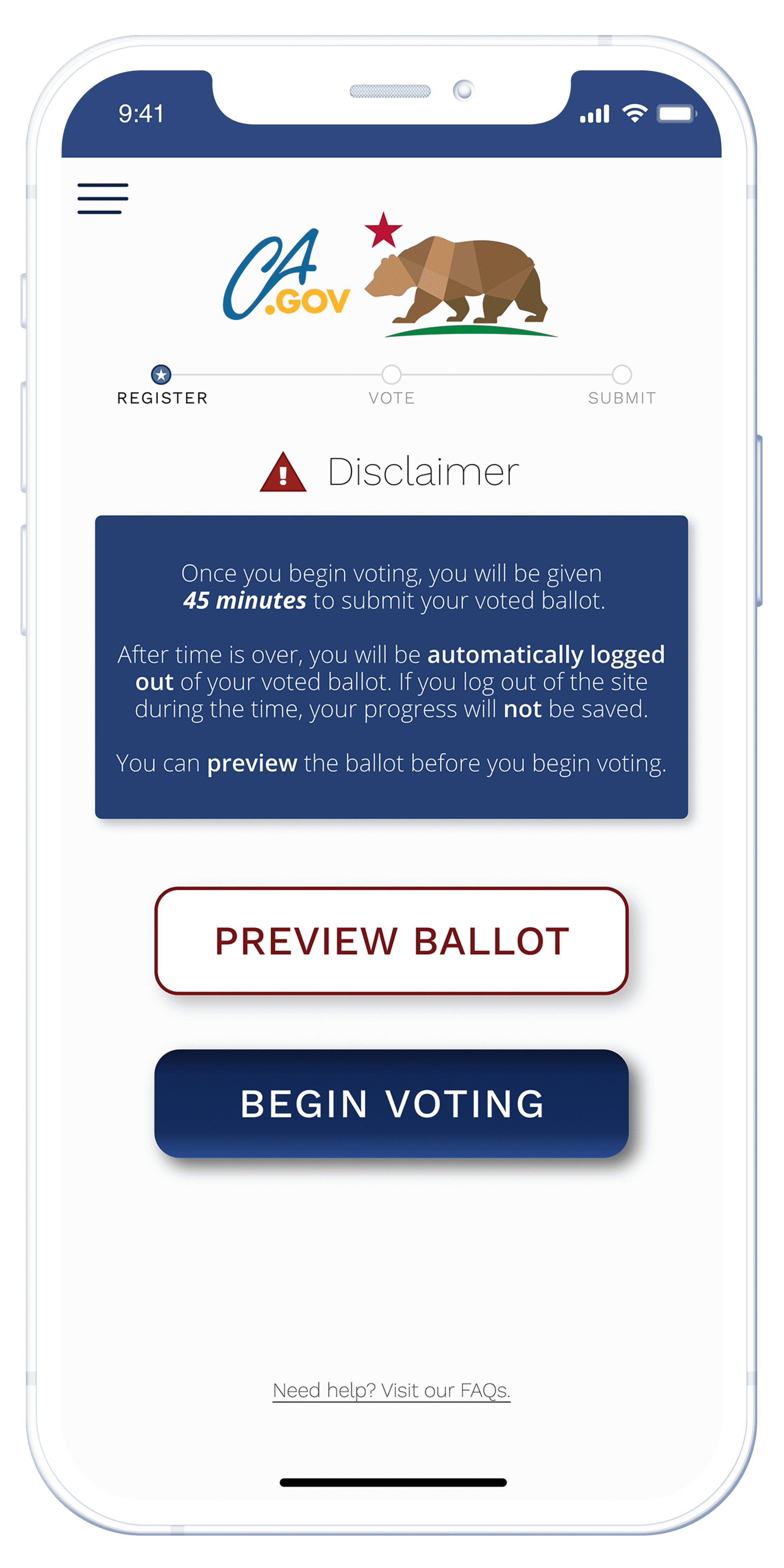
You will have approximately 45 minutes to complete and submit your voted ballot.
Once you have begun the voting process, a timer will appear at the top of your screen. If you do not wish to see the timer throughout the process, there is an option to hide the timer from your view.
Can I research candidates while I am completing my ballot?
Yes. The State of California does not have any rules barring an individual from bringing their phone into a polling station. Therefore, you have the ability to research candidates when completing your ballot.
However, we do not recommend looking up candidates after starting the voting process due to the 45-minute time constraint.
Based on your feedback, we have provided an example ballot that can be previewed before the voting process commences. You can research candidates using this preview ballot.
What if I made a mistake on my ballot? Can I go back and change my candidate selection?
Yes. After you have cast your votes, you will be directed to a ballot review screen. If you wish to change any of the selections made on your ballot, you can do so at this step in the process.
However, once you confirm that you have reviewed your voted ballot, no additional changes can be made to ballot selections.
Step 3: Submit & Track
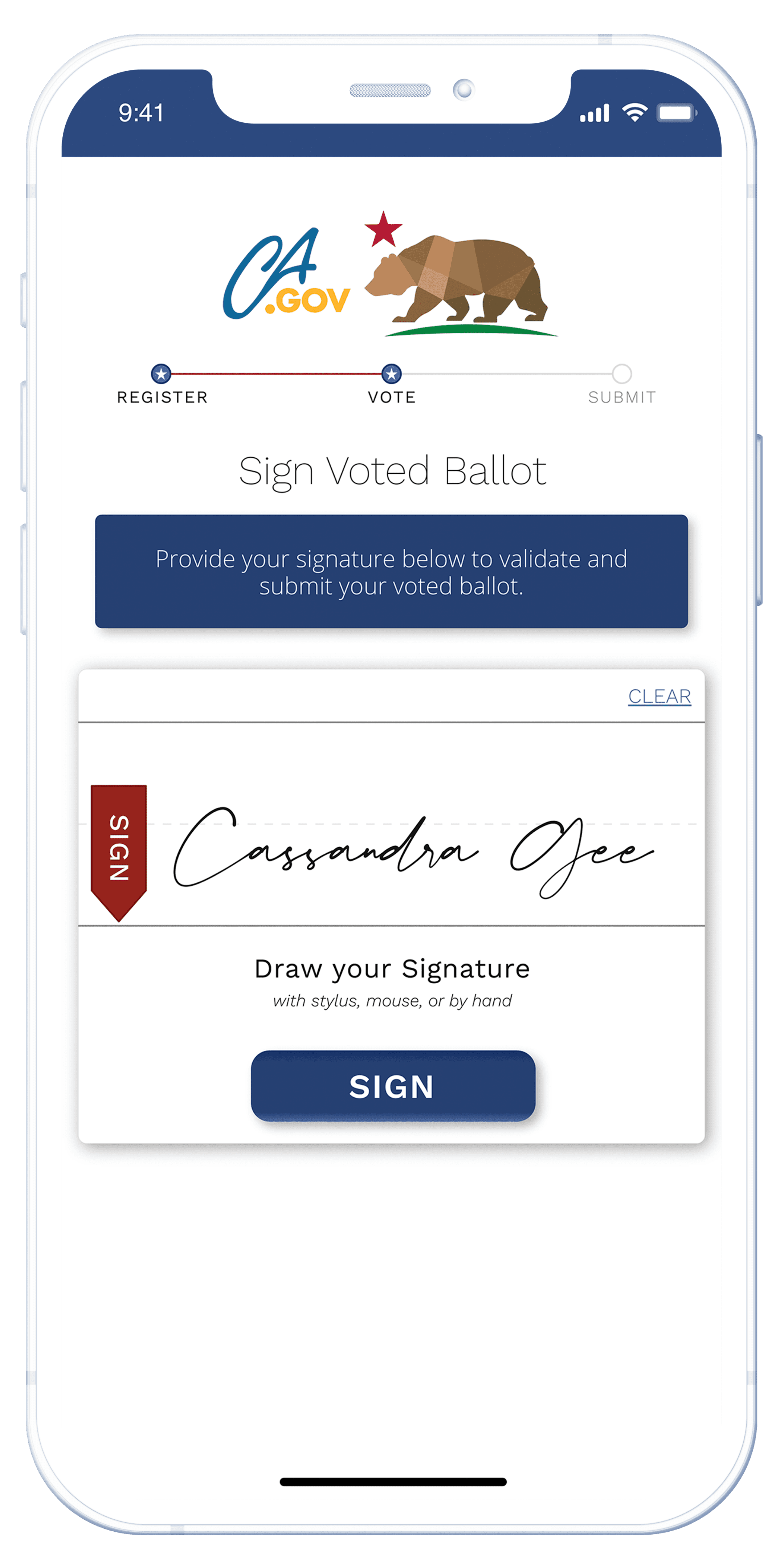
Our voter research showed that many individuals had mixed feelings about voting through an online platform, stemming mainly from security concerns related to facial recognition identification methods. However, research also revealed that voters felt that having a two-factor authentication for online sites provided an additional layer of security.
Therefore, in addition to the security measures taken when confirming a user's voter registration status, our site requires a electronic signature from the user in order to submit their final, reviewed ballot. This final step in the submission process further emphasizes the importance of a confidential vote to the user.
Will my vote remain confidential through this platform?
Yes. Once you have fully reviewed your voted ballot, you will be prompted to provide your electronic signature. By providing your signature and submitting through this platform, your vote will legally remain confidential.
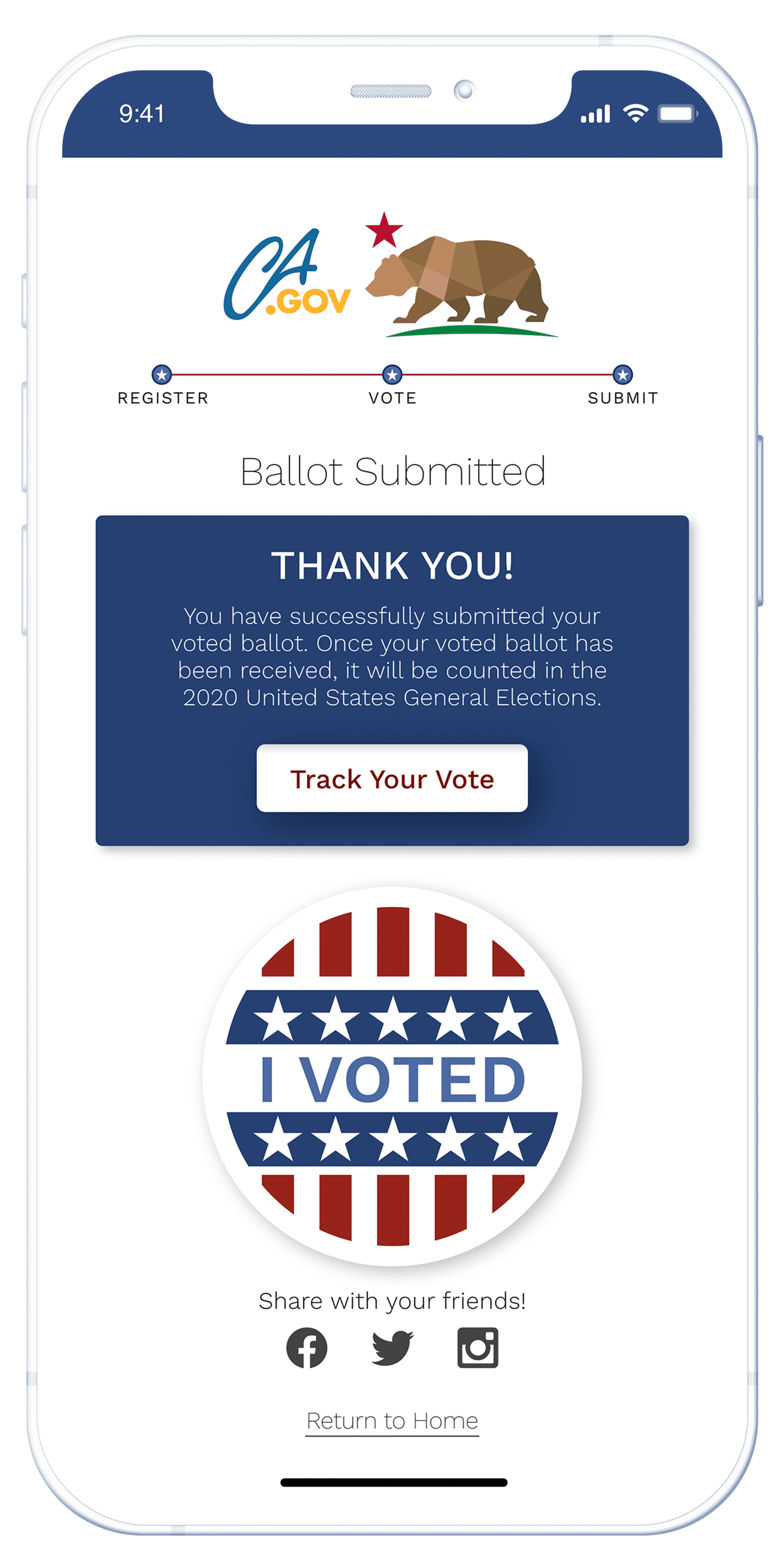
Will I receive an "I voted" sticker?
Unfortunately, we will not be mailing individual "I voted" stickers.
However, once your ballot has been submitted, you will have the option to share our electronic version of the sticker on any social media platform of your choosing.
We encourage you to share your electronic sticker and inspire others to get out to the polls!
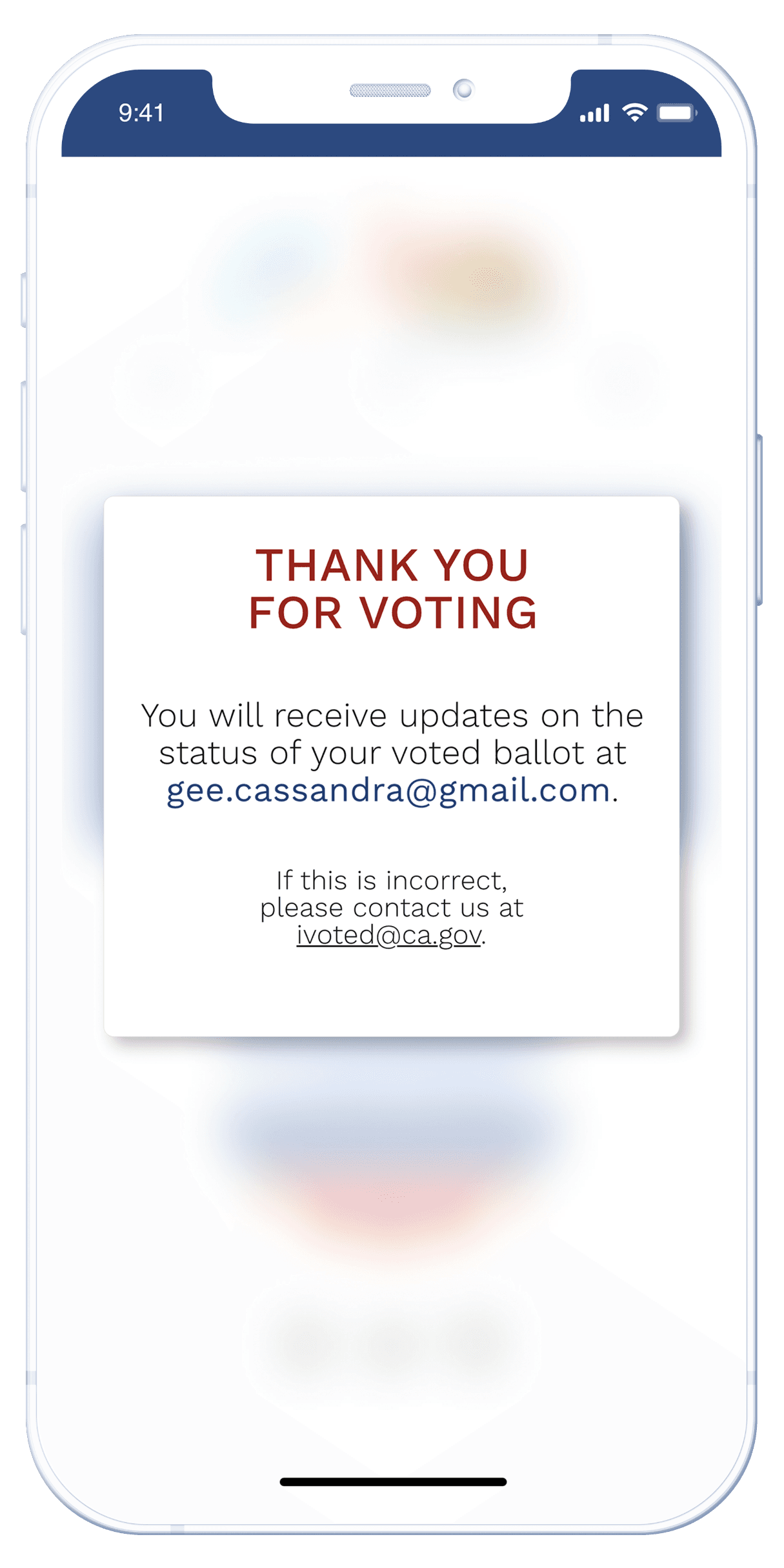
How will I know when my ballot has been counted?
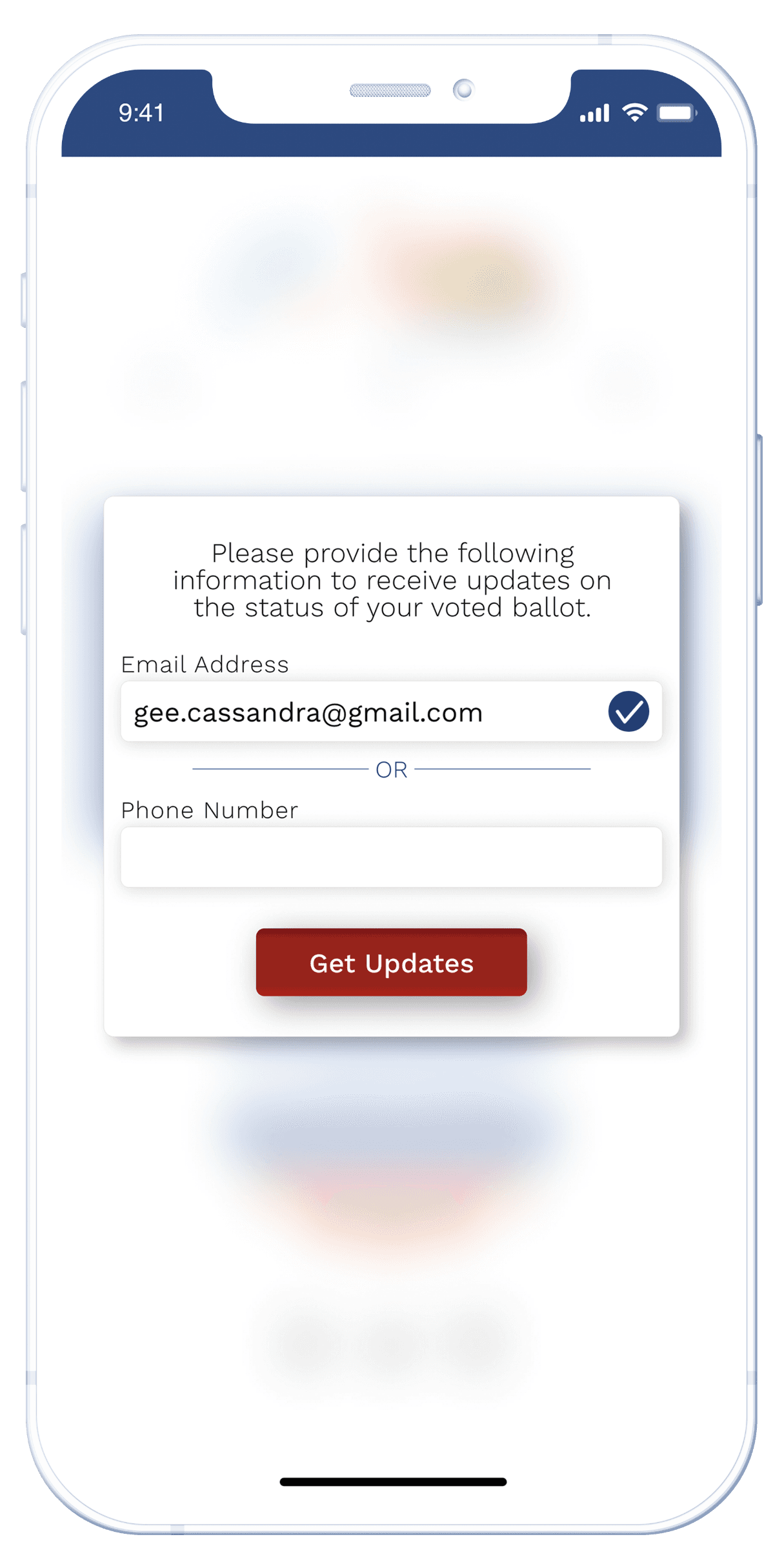
You will have the option to track your voted ballot by providing either your email address or your phone number. Once your vote has been counted, you will receive either an email or text update letting you know your vote has successfully been counted in the United States elections.
Security Architecture
Unique 6-digit voter registration PIN issued upon registration
Identity verification using driver's license, passport, or last four digits of SSN
Two-factor authentication throughout the voting process
Electronic signature required for final ballot submission
Post-submission ballot tracking via email or SMS confirmation
Ballot review screen with ability to correct selections before submission
Nonpartisan Visual Design
Developing the style guide required identifying the mindful, unbiased intersection between color psychology and political symbolism. Rather than eliminating the popular political color dichotomy, our team focused on how the psychologies associated with politically polarizing reds and blues could guide the user through the online voting process.
Red – Energy & Urgency
Used sparingly for high-stakes moments: important disclaimers, signature prompts, timer countdowns, and one-time call-to-action buttons. Applied tactfully to signal moments that require attention without causing anxiety.
Blue – Trust & Stability
Used more generously for recurring UI elements: progress indicators, standard call-to-action buttons, and general notifications. Blue induces serenity, trust, and stability — the foundation of how a voter needs to feel throughout the entire experience.
The Outcome
A Vote For Impact
The platform addresses the obstacle gap directly — and positions California as a pioneer in accessible, electronic democracy.
A study of West Virginia's mobile voting application Voatz showed that the ability to cast votes conveniently and electronically not only led to an increase in overall voter turnout, but also reduced the cost of voting for the state and helped reduce inequalities in voter participation. California has the unique opportunity to be one of the pioneer states in the movement towards remote, online voting.
In order for this online ballot submission platform to come to life, the State of California will have to increase investments in blockchain technology, application programming interfaces, marketing tactics, and employee trainings. Ensuring all overseas citizens have an approachable and trustworthy way to exercise their right to vote will take time and money — but the payoff will be worth it.
Measuring Success
Voted ballots submitted from overseas citizens
Raw vote rate increase year over year — the primary indicator the platform is closing the obstacle gap.
Number of overseas citizens who have registered to vote
Registrations initiated through the platform — measuring the effectiveness of the simplified registration flow.
Experience surveys for trust and security improvements
Qualitative feedback to continuously iterate on the trust signals that are central to the platform's value proposition.
Social media engagement — particularly "I voted" sticker shares
Social proof that the platform is building civic engagement momentum beyond the individual voter experience.
Featured Case Study

Product Strategy · Fintech
Case Study

E-Commerce Redesign
UX Design · Bootcamp